TLDR
Make six to ten coupons that fit the recipient’s real interests, not vague promises that sound romantic but never get redeemed. A practical DIY format is a 4-by-2.25-inch coupon with a 0.5-inch binding strip on the left. Add a specific offer, any necessary limits, and an optional “redeem by” line. Print on paper your printer can handle, cut the cards, and bind them with a staple, ribbon, or paper fastener.
A valentines coupon book printable is a small booklet of redeemable favors, treats, privileges, or shared activities. It can be romantic, but it does not have to be. The same project works for children, parents, friends, teachers, and anyone who would appreciate the promise of useful time together.
The best coupons are easy to understand and comfortable to redeem. “Breakfast of your choice this weekend” is more useful than “Anything you want.” Before designing the pages, decide who the book is for, what you can realistically offer, and whether each coupon needs a one-use rule, deadline, or scheduling note.
Valentines coupon book printable: choose the right version
Valentine’s Day is observed on February 14, and handmade cards have a long place in its card-giving tradition, as illustrated by the Library of Congress Valentine history collection. A coupon book builds on that handmade idea by turning each card into something the recipient can use later.
| Recipient | Best coupon style | Good visual direction |
|---|---|---|
| Partner or spouse | Shared experiences, practical favors, favorite meals and quiet time | Deep red, blush, cream, simple hearts or a favorite shared color |
| Child | Small privileges, one-to-one activities and choices within clear limits | Bright colors, large type, stars, animals or doodled hearts |
| Family member | Helpful tasks, meals, outings and time together | Warm colors, simple icons and space for a handwritten note |
| Friend or Galentine | Coffee dates, movie nights, encouragement and practical help | Playful pink, coral, lavender or bold retro graphics |
| Blank fill-in book | Open prompts that can be personalized after printing | Neutral borders, generous writing space and a low-ink background |
Choose one audience per booklet. Mixing “date night,” “skip one chore,” and “pick the family movie” in the same book can make the gift feel assembled at random. If you want an all-purpose set, use blank coupons with short prompts such as “This coupon is good for,” “Let’s make time for,” or “Your choice of.”
Set up a printable coupon sheet
You can build the page in a word processor, presentation program, or design app. This suggested layout is compact enough to feel like a booklet while leaving room for useful wording. It is a project recommendation rather than a required coupon standard.
| Element | Suggested measurement or setting | Why it helps |
|---|---|---|
| Finished coupon | 4 by 2.25 inches | Provides room for an offer, small icon and redemption details |
| Binding strip | 0.5 inch on the left | Keeps the staple or punched hole away from the main wording |
| Coupon body | About 3.5 by 2.25 inches | Leaves a clear writing and design area after the binding strip |
| Coupons per sheet | Six on a landscape US Letter page | Allows two columns and three rows with useful cutting space |
| Book size | Six to ten coupons plus a cover | Feels substantial without creating too many obligations |
| Inner text margin | At least 0.125 inch; more near the binding | Reduces the risk of trimming or binding into the wording |
Create one 4-by-2.25-inch rectangle, then add a vertical dashed line 0.5 inch from its left edge. Keep the coupon title and details to the right of that line. Duplicate the rectangle into two columns and three rows on a landscape page, leaving visible gaps or crop marks between cards. Print one test page on ordinary paper before committing to heavier stock.
What every coupon should contain
- A short title, such as “You Pick the Movie” or “Saturday Pancakes.”
- One sentence explaining exactly what the recipient receives.
- Any scheduling condition that genuinely matters, such as “Choose a Saturday this month.”
- An optional “one use” or “redeem by” line.
- A small signature, name, or personal message.
- Enough blank space to write a date or choice by hand.
Avoid filling the card with rules. Include a boundary only when it prevents confusion. A movie coupon may need no conditions, while an outing that depends on work schedules could say, “Choose a weekend date that works for both of us.”
Coupon wording people can comfortably redeem
A usable offer is specific, achievable, and welcome. It should not depend on the recipient asking for an undefined favor or reminding the giver repeatedly. Start with things you already enjoy doing, tasks you can reliably complete, and experiences that fit your available time and budget.
Romantic partner coupons
- Dinner at home: You choose the meal, and I will cook and clean up.
- Phone-free hour: One uninterrupted hour together with our phones put away.
- Your-choice date: Pick an at-home or local date within our agreed budget.
- Morning treat: Coffee, tea, or breakfast made for you on a mutually convenient morning.
- Memory night: Choose the photos, music, or movie from a favorite time together.
- Rest pass: I will handle one agreed household task while you take a break.
Family and kids’ coupons
- Pick the family movie for our next movie night.
- Choose tonight’s bedtime story, including one extra short book.
- Plan a 30-minute craft session using supplies we already have.
- Choose the dessert for an agreed family dinner.
- One helper pass for a reasonable age-appropriate task.
- Pick the music for one car ride.
- Choose a park or walking route for our next local outing.
For children, define choices before handing over the book. “Stay up 20 minutes later on a non-school night” is clearer than “Stay up as late as you want.” Parents can also add “ask an adult to schedule” where an activity requires travel, supplies, or supervision.
Friendship and Galentine coupons
- Coffee or tea together, my treat, up to an amount written on the coupon.
- A walk-and-talk date at a place we both choose.
- Help with one small organizing task for up to an hour.
- Your-choice movie night with snacks.
- A handwritten encouragement note delivered when you need one.
- A no-cost catch-up call scheduled around both calendars.
Useful blank-coupon prompts
- I’ll take care of…
- You get to choose…
- Let’s make time for…
- Redeem this when you need…
- Our next at-home adventure will be…
- This coupon is good for one hour of…
Add redemption details without making the gift feel formal
Coupons work better when both people know what redemption involves. A tiny footer can hold the practical information without taking over the design. Use fields such as “One use,” “Redeem by,” “Schedule with,” or “Your choice.” Leave the date blank if a deadline would create unnecessary pressure.
Check every promise with three questions: Can I afford it? Can I schedule it? Will this person actually enjoy it? Replace any uncertain offer before printing. If an activity has a spending limit, state it kindly and directly. If it depends on transportation or childcare, offer an at-home alternative on the same card.
Consent and preferences still matter, even in a playful romantic book. Coupons should offer welcome attention and shared experiences rather than create obligations. A recipient should always feel comfortable declining, adapting, or postponing an activity.
Choose paper and print a test copy
Standard printer paper is inexpensive and easy to fold or staple, but the coupons will feel more like small gift cards on light cardstock. A practical home-printing range is approximately 65- to 80-pound cover stock, provided the printer’s manual permits it. If your printer struggles with heavy sheets, use ordinary paper and attach the printed coupons to slightly larger colored-paper rectangles.
Print at 100 percent or “actual size” when physical dimensions matter. A “fit to page” setting can shrink the cards. Test one sheet, measure a coupon with a ruler, check that the back side is oriented correctly if you print double-sided, and only then print the final pages.
A white or pale background uses less ink and makes handwritten details easier to read. For a low-ink version, rely on borders, line art, and one accent color rather than a full-page background. If children will decorate the coupons with crayons or markers, the paper considerations in this guide to choosing paper for printable coloring pages can help you match the sheet to the decorating tools.
Preparing an edge-to-edge professional file
Home printers commonly leave an unprinted margin, so a white border is the simplest home setup. If a professional printer will trim color all the way to the edge, ask for its current file specifications before ordering. PrintInvitations describes a 0.125-inch bleed as a common setup and recommends keeping important content 0.125 to 0.25 inch inside the trim line. YouStickers likewise distinguishes the bleed, margin, and safe zone around a cut design.
Using that 0.125-inch bleed on every side, a 4-by-2.25-inch finished coupon would need a 4.25-by-2.5-inch artwork file. That larger measurement is the file size, not the final trimmed size. Extend background colors into the bleed, but keep names, coupon wording, borders, and small hearts inside the safe area.
Paper and finish choices vary by provider. For example, PrintInvitations currently lists smooth, felt, eggshell, and pearlescent papers along with several finish options. Confirm current availability and consider writability before choosing a coating, especially if dates or redemption notes will be added by hand.
Cut and bind the booklet
- Let freshly printed sheets dry before stacking them, especially if the design uses large areas of ink.
- Cut the long horizontal lines first, then separate the individual coupons with shorter vertical cuts.
- Arrange the cover first and place the coupons in the order you want them redeemed or discovered.
- Align the left binding strips and hold the stack with a small clip.
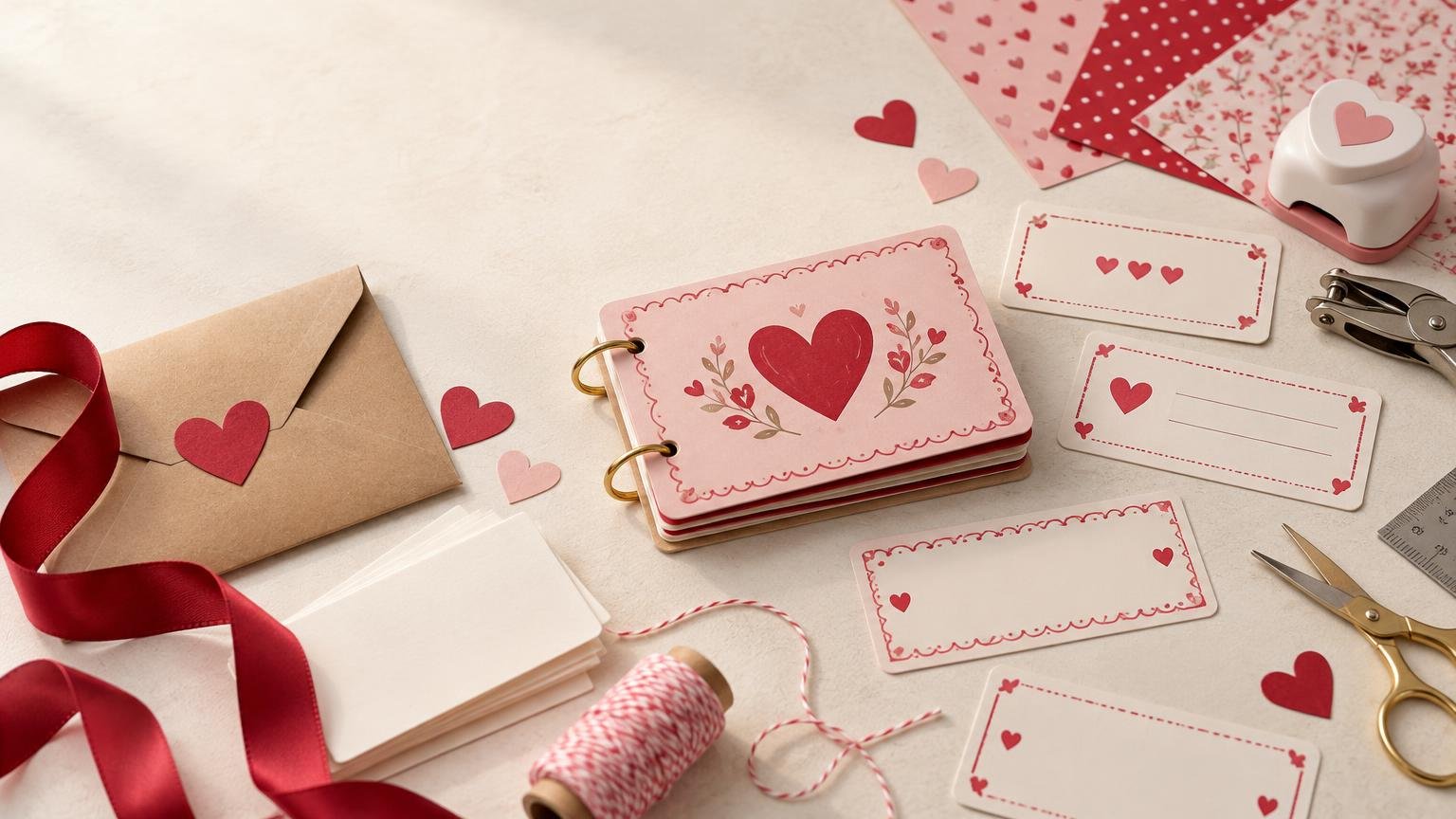
- Add one or two staples through the binding strip, or punch one hole and secure the stack with narrow ribbon, baker’s twine, or a paper fastener.
- Check that every coupon can be read and removed without cutting through the offer.
No binding tool is required. A single paper fastener lets the cards fan out, while ribbon looks decorative but can loosen. Staples are the fastest option. If clean removal matters, place a dashed “cut here” line just to the right of the binding strip and include a small pair of scissors when presenting the gift.
Finish the presentation
Add a cover with the recipient’s name and a simple title such as “Time Together,” “A Little Book of Yes,” or “Made Just for You.” Slip the finished book into an envelope, tie it to a small treat, or wrap it with a narrow paper belly band. An envelope with internal space of at least 4.25 by 2.5 inches will accommodate the suggested booklet, although a thicker book may need extra room.
A heart-shaped seal can make a plain envelope feel finished. You can draw one, cut one from adhesive paper, or order custom envelope-seal stickers when producing several matching books for a classroom, club, customer event, or family gathering. Keep the cover and packaging consistent by repeating one typeface, one heart motif, and two or three colors.
Make the promises before decorating the pages
Begin with the recipient, not the artwork. Write six to ten realistic offers, clarify any limits, and remove anything that would be awkward to schedule or redeem. Then place the wording into a 4-by-2.25-inch layout, print a plain-paper test, and choose the simplest binding method available.
A beautiful coupon book is pleasant to open. A thoughtful coupon book is pleasant to use. Specific wording, manageable promises, and a little blank space for personal notes will do more for the gift than elaborate graphics ever could.
References
