TLDR
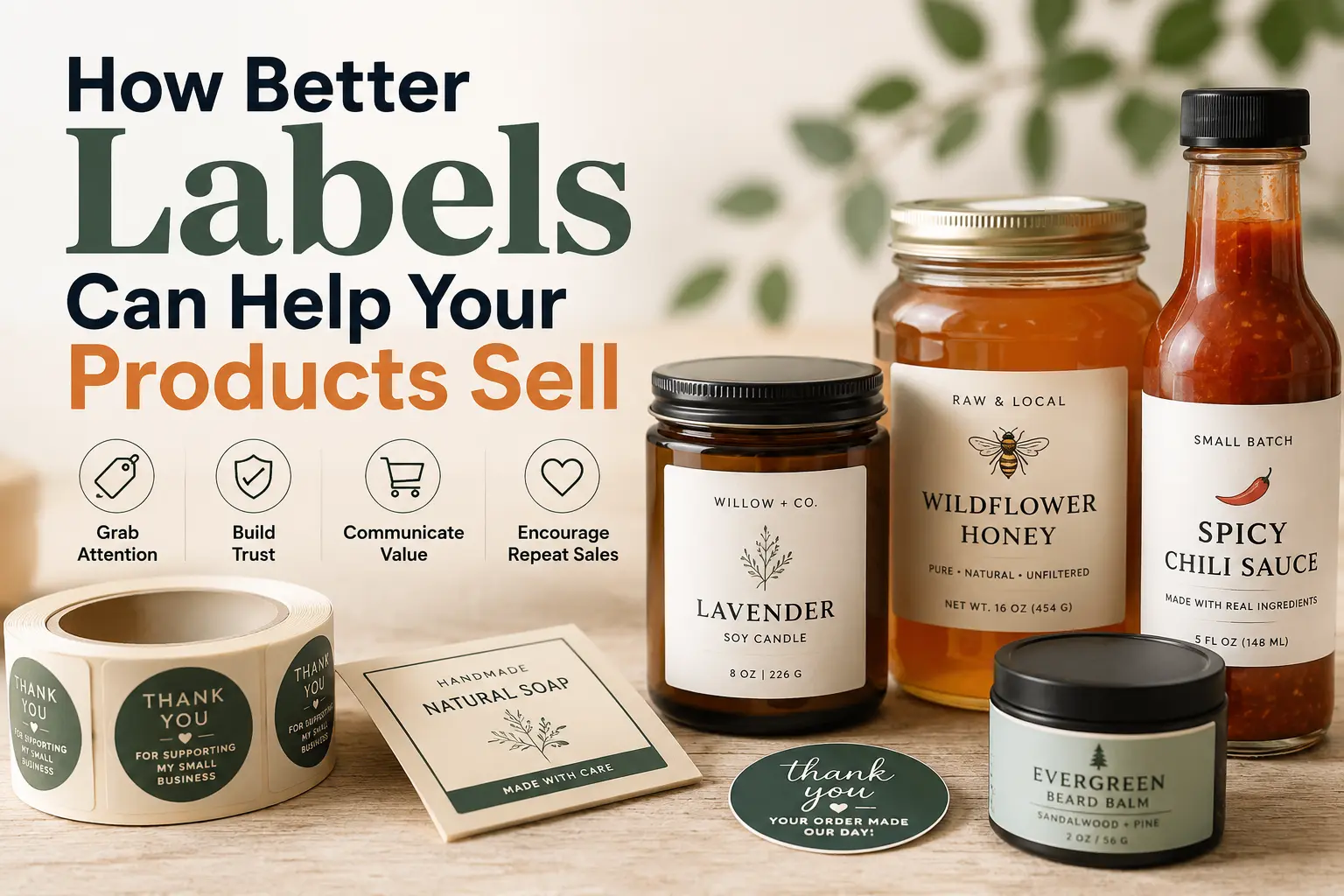
Better labels can help your products sell because they make the product easier to understand, easier to trust, and easier to choose.
A strong label does not just look nicer. It explains what the product is, who it is for, why it matters, and what the buyer should know before purchasing.
For small businesses, better labels are often one of the most practical packaging upgrades. You can improve shelf appeal, product photos, customer confidence, and brand consistency without redesigning your entire package.
If you need custom product labels for jars, bottles, boxes, bags, candles, food packaging, or small business products, CustomStickers.com offers custom roll labels and sheet labels in multiple sizes, shapes, and finishes.
Better Labels Do More Than Decorate
A product label has a short window to do its job.
Someone sees the product on a shelf, in a market booth, on a website, or inside a shipped order. They make a quick judgment. Does this look trustworthy? Do I understand what it is? Does it fit what I need? Does it feel worth the price?
That is why better labels can help your products sell. A label is part design, part information, and part sales tool. It can make a handmade product feel more finished. It can make a food product feel safer and clearer. It can make a candle, soap, sauce, spice blend, supplement, jar, bottle, pouch, or box feel like it belongs in a real product line.
Bad labels create friction. Better labels remove it.
And in product packaging, less friction usually means a better chance at the sale.
Labels Help Customers Understand the Product Faster
A good product label answers the basic question right away: what is this?
That sounds simple, but many labels fail here. The brand name is large, the decorative artwork is nice, but the actual product name is tiny. A customer should not have to study the package to figure out whether they are holding strawberry jam, chili oil, lavender soap, beard balm, honey, dog treats, or vanilla candle wax.
Start with clarity.
A better label usually makes these details easy to find:
- Product name
- Flavor, scent, color, or variety
- Main benefit or use case
- Size, weight, or quantity
- Important ingredients or materials
- Storage or use instructions
- Brand name or maker name
This matters online too. Product photos carry a lot of the buying decision. If a label is too small, cluttered, or low contrast, the customer may not understand the product from the image alone.
A clear label saves the customer effort. That matters more than people think.
Better Labels Build Trust
Customers notice when a label feels rushed.
They may not say, “This label has poor hierarchy and inconsistent spacing.” They are more likely to think, “This looks homemade,” or “I’m not sure about this one.”
That can be unfair, especially when the product itself is excellent. But packaging sets expectations. If the label looks careful, the product feels more credible. If the label looks sloppy, the product has to work harder to earn trust.
Better labels can signal:
- The product was made with care
- The business is organized
- The brand pays attention to details
- The item is giftable
- The product is safe to use or consume
- The business is ready for repeat customers
For food, cosmetics, candles, supplements, and body products, trust matters even more. People are putting the product in their home, on their skin, or in their body. A clear, polished label helps them feel more comfortable buying.
Labels Create Shelf Appeal
Shelf appeal is not only for big retail brands. It matters at farmers markets, craft fairs, boutique shops, pop-ups, online marketplaces, and product photos.
A product has to catch attention without looking chaotic. Better labels can help with that balance.
Strong shelf appeal often comes from:
- Clear contrast
- Readable text
- Consistent brand colors
- A simple product name
- A shape that fits the package
- Good use of white space
- A finish that matches the product
- A design style that fits the price point
For example, a clean matte label may work well for a natural candle brand. A bright gloss label may work better for a fruit sauce or candy jar. A clear label may help when the product itself is visually appealing, like honey, bath salts, coffee beans, or colorful drinks.
The goal is not to make the loudest label. The goal is to make the easiest product to notice and understand.
Labels Help Support a Higher Price
Better labels can make a product feel more complete, which can support stronger pricing.
This does not mean a label lets you charge anything you want. The product still has to be good. But packaging affects perceived value. A jar of jam with a plain office label feels different from the same jar with a well-sized, water-resistant, professionally printed label.
That difference matters for:
- Gift products
- Specialty foods
- Candles
- Skincare
- Handmade goods
- Boutique retail items
- Wedding favors
- Subscription boxes
- Small batch products
A better label can make the product feel more suitable as a gift. It can also make the product feel more retail-ready. That can help when selling to stores, preparing wholesale samples, or raising prices after improving the overall brand presentation.
Small packaging upgrades can make the product easier to justify at the price you already want to charge.
Better Labels Make Your Brand More Memorable
A customer may buy once because the product looks interesting. They come back because they remember it.
Labels help with that.
Consistent label design makes your products easier to recognize across different sizes, scents, flavors, and product lines. If every label looks unrelated, customers have to relearn the brand each time. If your label system is consistent, the products start to feel connected.
A strong label system may use:
- The same logo placement
- The same typefaces
- The same label shape
- A consistent color palette
- Different accent colors for each flavor or scent
- Similar layout across every product
- Matching finish across a collection
This is especially helpful when you sell multiple products. A candle brand with ten scents needs variety, but it also needs consistency. A sauce brand with five flavors needs each flavor to stand apart while still looking like the same company.
Better labels help your product line feel organized. That makes the brand easier to remember.
Labels Can Explain the “Why” Behind the Product
Some products need more than a name.
A customer may want to know what makes the product different. Is it small batch? Is it handmade? Is it spicy, mild, unscented, organic, vegan, cold processed, locally sourced, refillable, reusable, or made for sensitive skin?
A label can answer those questions quickly.
Useful callouts might include:
- Small batch
- Handmade
- Locally roasted
- Raw honey
- Unscented
- Made with olive oil
- No added sugar
- Refillable
- Gluten-free
- Limited edition
- Best seller
- New flavor
- Safe for sensitive skin
Be careful here. Only make claims you can support. Do not add trendy words just because they sound good. A simple, true claim is stronger than a label full of vague selling points.
Good labels tell the truth clearly.
Better Labels Improve Product Photos
If you sell online, your label has to work in photos.
A label that looks fine in person may disappear on a product page. Small text, low contrast, thin fonts, busy backgrounds, and shiny glare can all make the product harder to read.
Better labels help product photos by giving the camera something clear to capture.
For online sales, consider:
- Larger product names
- Stronger contrast
- Less tiny text on the front
- Matte finishes if glare is a problem
- Clean front-facing label placement
- Simple backgrounds for product photos
- Label colors that stand apart from the product
This matters for ecommerce, Etsy, Amazon, Shopify stores, wholesale catalogs, social media, and email marketing. Your product photo may be the first “shelf” the customer sees.
A label that reads well in photos can improve the first impression before the customer ever holds the product.
Labels Can Reduce Customer Questions
A good label can also reduce confusion after the sale.
That matters because confused customers hesitate. They may not buy. Or they may buy and then ask questions that could have been answered on the package.
Better labels can explain:
- How to use the product
- How much to use
- Where to store it
- When to use it
- What the product contains
- Who it is for
- What scent, flavor, or size it is
- How to reorder
- Where to scan for instructions
For some products, a QR code can help. You can link to instructions, recipes, care guides, refill information, or a product page. Keep the QR code useful. Do not add it just to fill space.
A label should make the buying and using experience easier.
Match the Label Material to the Product
Design matters, but material matters too.
The right label material depends on how the product will be stored, shipped, handled, and used. A dry pantry product does not need the same label as a refrigerated drink or bath product.
Consider the environment:
- Will the product go in a refrigerator?
- Will the label face condensation?
- Will customers handle it with wet or oily hands?
- Will the product be shipped?
- Will it sit in sunlight?
- Will it be used in a bathroom, kitchen, cooler, or outdoor setting?
- Will it need to hold up long enough for repeat use?
For many product labels, water resistance and scratch resistance are worth considering. This is especially true for jars, bottles, candles, bath products, sauces, beverages, and food packaging.
CustomStickers.com offers custom labels in roll and sheet formats, including matte, gloss, clear, circle, rectangle, oval, and die cut label options. That gives small businesses room to choose a label that fits the package, not just the design.
A pretty label that peels, smears, or scuffs too easily can work against the product. The material should match the job.
Use Roll Labels When You Need Speed
If you label products in batches, roll labels can make the process easier.
Sheet labels are helpful for small runs, testing, gifts, and mixed designs. Roll labels are often better when you need to label many of the same product quickly and consistently.
Roll labels work well for:
- Product jars
- Bottles
- Boxes
- Bags
- Candles
- Food containers
- Shipping labels
- Warning labels
- Barcode labels
- Reorder labels
They are easier to peel and apply in a production flow. If your business is labeling dozens or hundreds of products at a time, that saved time matters.
Better labels are not only about how the product looks. They can also make fulfillment cleaner and faster.
Common Label Mistakes That Hurt Sales
Most label problems are fixable. The hard part is noticing them before the customer does.
Avoid these mistakes:
- Making the brand name large but the product name too small
- Using low-contrast colors
- Choosing a label shape that does not fit the container
- Putting too much text on the front label
- Using thin fonts that disappear in photos
- Printing on weak material for wet or oily products
- Forgetting required product information
- Changing label style too much across a product line
- Using low-resolution artwork
- Skipping proof review
- Making claims that are unclear or unsupported
The best label is not always the most artistic one. It is the one that helps the customer choose with confidence.
A Simple Label Upgrade Checklist
Before redesigning everything, start with a basic review.
Ask these questions:
- Can someone tell what the product is in two seconds?
- Is the product name easy to read?
- Does the label match the price point?
- Does the design fit the product category?
- Is the label material right for the product environment?
- Does the label look good in photos?
- Are the important details easy to find?
- Is the branding consistent across the product line?
- Does the label include required information?
- Would the product look at home in a retail display?
If you answer no to more than a few of these, better labels may be one of the easiest ways to improve the product presentation.
Final Thoughts
Better labels can help your products sell because they make the product easier to notice, understand, trust, photograph, and remember.
You do not need to overcomplicate the design. Start with clarity. Make the product name obvious. Choose a label shape that fits the package. Use materials that match how the product will be handled. Keep the branding consistent. Add useful information without crowding the design.
A better label cannot save a bad product. But it can help a good product get the attention it deserves.
FAQs
How can labels help a product sell?
Labels help products sell by making the product easier to understand, more trustworthy, more visually appealing, and easier to compare with other options. A clear label reduces hesitation and helps customers choose faster.
What makes a product label look professional?
A professional product label usually has clear hierarchy, readable text, good spacing, strong contrast, consistent branding, and a material that fits the product. The design should look intentional, not crowded.
Are custom labels worth it for small businesses?
Yes, custom labels are often worth it for small businesses because they improve product presentation without requiring a full packaging redesign. They can be used on jars, bottles, boxes, bags, candles, and other products.
Should I use matte or gloss labels?
Use matte labels for a softer, more natural look and less glare. Use gloss labels when you want brighter color and a more polished shine. The right finish depends on the product category, brand style, and how the product will be photographed.
What information should a product label include?
Most labels should include the product name, brand name, size or quantity, flavor or scent, and basic use information. Food, cosmetics, supplements, and other regulated products may need additional required information.
Are waterproof labels better?
Waterproof or water-resistant labels are better for products exposed to moisture, condensation, oils, bathrooms, kitchens, coolers, or frequent handling. Dry indoor products may not need the same level of durability.